a clergyman may be apparently as useless as a cat, but he is also as fascinating, for there must be some strange reason for his existence (GK Chesterton): one retired Anglican septuagenarian clergyman's THOUghts, discOverings, readings, scribbLes, wOndeRings and dooDles exploring that strange reason
Wednesday, 9 December 2015
A Kneeler on Wheels
Sunday, 25 January 2015
On the Merits of Liturgy and the Church Calendar
Liturgy, at its best, is more like the tracks of the train than the whistle. It’s silent and sturdy and, though almost unnoticed, it leads us to where our hearts long to go. In perhaps the most quoted address on liturgy, C.S. Lewis states, that liturgy is most useful “when, through long familiarity, we don’t have to think about it. As long as you notice, and have to count, the steps, you are not yet dancing but only learning to dance. A good shoe is a shoe you don’t notice. Good reading becomes possible when you need not consciously think about eyes, or light, or print, or spelling. The perfect church service would be one we were almost unaware of; our attention would have been on God.…from Tish Harrison Warren, a priest in the Anglican Church in North America, in a piece on her discovery and appreciation for the church calendar in Christianity Today's excellent "Her.meneutics" here.
Liturgy's trustworthy tracks, along with the church calendar, keep our worship and personal devotions on course as, year after year, they carry us along through the story of Jesus from Advent through Easter and a focus on discipleship for the rest of the year. The accompanying lectionary ensures that we are all, including preachers, at least exposed to themes with which we might not otherwise be inclined to engage.
Monday, 21 April 2014
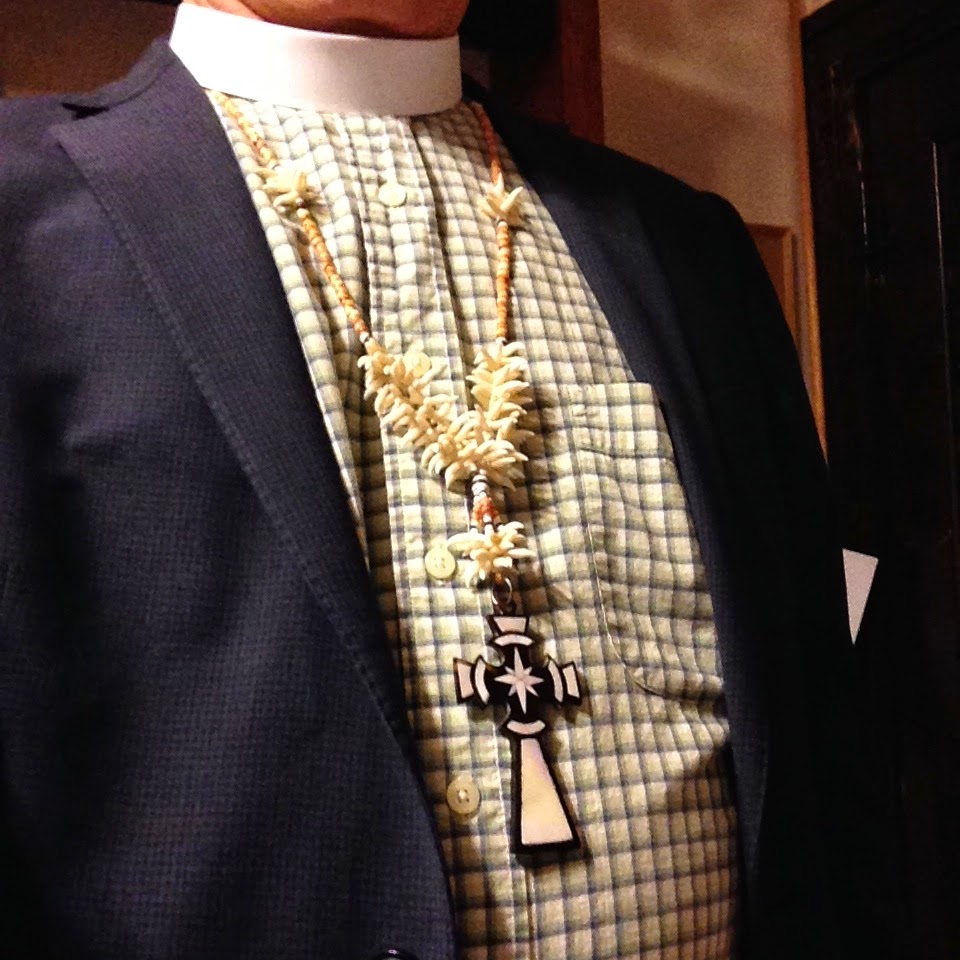
Collared: the Full Easter
Wednesday, 22 January 2014
Sunday, 15 September 2013
Seeing Double: an iPhotographic Double Portion—Waterton Lake
Instead of your shame there shall be a double portion; instead of dishonour they shall rejoice in their lot; therefore in their land they shall possess a double portion; they shall have everlasting joy. (Isa 61:7)
Monday, 5 August 2013
Towards Another Great Awakening: a Revolutionary, Revivalist Archbishop of Canterbury!
![]() |
| Photo Credit: New Wine UK |
…when things in the Church are not going well, or in bits of the Church historically, God does not repair; He renews. He doesn’t just stitch it up; He gives us something new.
…There has never been a renewal of the Church in Western Europe without a renewal of prayer and the life of religious communities; never. If we want to see things changed, it starts with prayer. It starts with a new spirit of prayer, using all the traditions, ancient and modern, of prayer. When it comes, it will be linked to what has gone before, but it will look different, because it is a new renewal for new times. God’s created community is perfectly designed for its time and place. It always comes from below; almost always. It comes from Christians seeking Christ, and is often - says I, looking at the one bishop I can see from here - is often opposed by church leaders, and especially archbishops.
We must have a new movement of prayer, and I commit myself to opposing it, because that seems to work.
…we are in a time of revolution, and we need another revolution in the Church. What it looks like, I do not know, but I want to be in it. What it feels like is Jesus-centred, fire-filled, peace-proclaiming, disciple-creating, and the Church word for this revolution is revival.O, yes! Will you not revive us again, O LORD! Read the rest here.
Next Prayer for Revival at StB on Wednesday, August 14th, from 11am to 5pm. Come and go as you like.
Monday, 24 June 2013
Do, Re, Mi, The Birth of John the Baptist and Music Being the Food of Love
In 1050 a monk named Guido died in his hometown of Arezzo in Italy. Few people nowadays seem to have heard of him, but Guido d'Arezzo is one of the most important names in cultural history. Nearly anyone with even a nursery level education is in debt to Guido d'Arezzo. It was Guido who invented the system of staff notation used in music to the present day. He is also the inventor of solfeggio to designate the notes of the diatonic scale. The final syllable of his name, Guido, provides the first note used in solfeggio—the note do.
Now, just why are we talking about Guido d'Arezzo on the feast of St. John the Baptist? Well, three hundred years before Guido there lived another monk named Paul the Deacon. This monk is best known for his history of the Lombards, but he also composed liturgical hymns in his spare time. One of those hymns he wrote for today's feast, the birth of St. John the Baptist. Remembering that Latin word order depends very little on logical sequence, we consider the first stanza of that hymn, which goes like this:
Ut queant laxis = "so that your servants" Resonare fibris = "may sing with relaxed throats"Mira gestorum = "of the marvels of your works"Famuli tuorum = "your servants"Solve poluti = "release the stain of"Labii reatum = "their sinful lips,"Sancte Johannes = "Holy John"
Looking closely at these lines, we observe that if we read the first syllable of lines two through seven in sequence, we get: "re-mi-fa-so-la-si." Each of these syllables in the hymn moves up one note on the diatonic scale.
When, three centuries later, Guido d'Arezzo worked out the details of his solfeggio, he simply took each note from the first syllable of the lines of Paul the Deacon's hymn for the feast of John the Baptist. The hymn's first syllable, ut, not conducive to being sung by itself, was changed to do, the second syllable of Guido's name. (Respectfully to Julie Andrews, it has nothing to do with a female deer or a needle pulling thread.)Music to my eyes. The wonderfully whimsical commentator is Patrick Henry Reardon. (“Summer 2013 - The Daily Devotional Guide by Patrick Henry Reardon.” The Fellowship of St. James. iBooks.)
Tuesday, 27 November 2012
A Seasons of the Church Year Calendar
Friday, 9 November 2012
On the Strangeness of Being Clergy
a favourite phrase of mine from the great Richard Hooker, our common imbecility as Archbishops.Far be it from me to comment on that from my much humbler station. It reminded me, however, of a couple of descriptions of those of us at my level. For example, Alistair McGrath shares a rather similar description of some nineteenth century pastors as
thin, vapid, affected, driveling little doodles. (Christianity’s Dangerous Idea: the Protestant Revolution—a History from the Sixteenth Century to the Twenty-first (HarperOne, 2007), p369I fear such doodlery still exists. I catch glimpses of it from the corner of my eye in myself some days.
And then there's the much kinder GK Chesteron,
A clergyman may be apparently as useless as a cat, but he is also as fascinating, for there must be some strange reason for his existence. Orthodoxy (Logos ebook) p289There must be some truth in it all. Canon 17 of our erstwhile Diocesan Canons deals with the
Intrusions and the Inhibition of Strange ClergymenMost of us remain uninhibited as useless, but fascinating, doodles. Some rise to the dizzy heights of ArchEpiscopal imbecility. It puts the idea of being fools for Christ in a whole new light!
Anglicanism is so much fun.
Sunday, 21 October 2012
Anglican unDoctrine
From here.Many Anglicans know, and all should, that Archbishop of Canterbury Geoffrey Fisher (d. 1972) famously said about Anglicanism, “We have no doctrine of our own. We only possess the Catholic doctrine of the Catholic Church enshrined in the Catholic Creeds, and these creeds we hold without addition or diminution. We stand firm on that rock.” These words ought plaster the top of every formation handout given to Anglican in parish formation classes. ++Fisher’s statement is profound, scriptural, patristic, and humble. Its truth guides our tradition.
Sunday, 12 August 2012
Roller Beauty…
Monday, 23 July 2012
Jesus Only: Archbishop George Carey
Let's not have any truck with bland theology, that Jesus is just one option among many. Dialogue with other faiths is very important, but I can respect another faith and believer of that faith by saying I believe that Jesus Christ is the only way of salvation. Do with that truth what you may, but my job is to say that to you.Amen and amen.
Wednesday, 23 May 2012
Tuesday, 10 April 2012
Moments When I Love My Job
This little beauty is Claire Simone Moses Randle, baptized in the Name of the Father, Son and Holy Spirit at St Barnabas along with her sister Katherine Rose Moses Randle in the Easter Vigil last Saturday.
I had just lifted her from the font. She looked at me very thoughtfully and I looked back. The moment reminded me of something I read in October last year by The Right Revd Dr Kelvin Wright, Bishop of Dunedin, New Zealand, where he described meeting his first granddaughter for the first time. This is what he wrote:
I was rewarded with an amazing treasure: she looked at me and smiled and wordlessly enquired who I was. It is an affirming thing to be seen and known, but especially by someone so utterly undefended and pure.Exactly. I was moved by Bishop Wright's insight and I was moved by my encounter with Claire.
I have a great job.
Monday, 26 March 2012
EASTER: a Poem by Emily Jane Alexandra Berringer
Easter means candy, chocolate and cake,
But it can mean much, much more,
It can mean he has risen!
It can also mean CANDY GOLORE!
It can mean more candy more, more, more!
It can mean on the third day he rose again,
Also it can mean a big chocolate hen!
Easter can mean lots of different things,
Easter can mean chocolate and cake
But it also means Jesus and the cross for heavens sake!
(Emily is my granddaughter who will be ten years old just after Easter)
Saturday, 3 September 2011
Saturday, 2 July 2011
Monday, 30 May 2011
Morning Prayer
I love that. Psalm 65:7ff
Tuesday, 10 May 2011
The View from the Dining Room Where I Am
-
That we should be doing this in Family Violence Prevention month is heart breaking and challenging. I'm not going to try and soften an...
-
Jesus gives us words of comfort: don’t be troubled, trust God, trust in me, I am going to prepare a place for you, when everything is ready ...
-
“There is a time for everything,a season for every activity under heaven,” wrote Solomon in that first reading. “A time to be born and a ti...