Showing posts with label Same Sex Marriage. Show all posts

Sunday, 3 July 2016

Pray for General Synod 2016


The Anglican Church of Canada posted this prayer For General, Provincial, or Diocesan Synods from The Book of Common Prayer on its Twitter feed the other day. "Amen!" pray I. May the all the mind of our Saviour Jesus Christ be fulfilled, indeed, particularly as regards the momentous changes proposed for our Marriage Canon during this Synod. 

I am also praying the first of the two prayers For General, Provincial, or Diocesan Synods which begins on the page before: 
ALMIGHTY and everlasting God, who by thy Holy Spirit didst preside in the Council of the blessed Apostles, and hast promised, through thy Son Jesus Christ, to be with thy Church to the end of the world: We beseech thee to be present with the General Synod now [or about to be] assembled in thy Name. Save its members from all error, ignorance, pride, and prejudice; and of thy great mercy vouchsafe so to direct, govern, and sanctify them in their deliberations by thy Holy Spirit, that through thy blessing the Gospel of Christ may be faithfully preached and obeyed, the order and discipline of thy Church maintained, and the kingdom of our Lord and Saviour enlarged and extended. Grant this, we beseech thee, through the merits and mediation of the same Jesus Christ our Lord. Amen. (BCP 42-43)
It seems to me this prayer fleshes out how Jesus' mind for his Church ought to be fulfilled: protected from error, ignorance, pride and prejudice; directed, governed and sanctified by the Holy Spirit of Truth; so the transforming and saving Gospel of Christ can continue to be faithfully preached and obeyed; the Church's order and discipline conserved; and the Kingdom of God properly enlarged and extended. 

Lord, have mercy! Please pray. 

Gene+

Monday, 22 December 2014

The Anglican Communion's Inter-Anglican Standing Commission on Unity, Faith and Order Has Urged The Anglican Church of Canada Not to Amend Its Marriage Canon

Something of which we Anglicans need to be aware:
The Inter-Anglican Standing Commission on Unity, Faith and Order (IASCUFO) has urged the Anglican Church of Canada not to amend its marriage canon (church law) to allow the marriage of same-sex couples, saying such a move would “cause great distress for the Communion as a whole, and for its ecumenical relationships.” 
The IASCUFO’s statement came in response to a request from the Canadian church’s Commission on the Marriage Canon for an opinion about proposed changes to Canon 21 that would allow for same-sex marriages. Canon Kenneth Kearon, secretary general of the Anglican Communion, decided IASCUFO would be the “most appropriate” body within the Communion to deal with such a question. (See more here.)
Back in September I posted some information on The Anglican Church of Canada's Commission on the Marriage Canon to which IASCUFO refers. That post included a link to the more than two hundred submissions received by the Commission (including my own) here.

Please pray that the Holy Spirit's direction would be clearly heard and obeyed concerning this difficult and divisive matter and that The Anglican Church of Canada will respond humbly and wisely.


Monday, 29 September 2014

Submissions to The Anglican Church of Canada's Commission on the Marriage Canon Concerning the Marriage of Same Sex Couples

At the moment, there is a new and detailed portrait of thinking across the Anglican Church of Canada on same sex marriage on the national church's website. It exists because near the close of General Synod in Halifax, June 2013, there was a bit of an end run and flurry resulting in the following:
Be it resolved that this General Synod
direct the Council of General Synod to prepare and present a motion at General Synod 2016 to change Canon XXI on Marriage to allow the marriage of same sex couples in the same way as opposite sex couples, and that this motion should include a conscience clause so that no member of the clergy, bishop, congregation or diocese should be constrained to participate in or authorize such marriages against the dictates of their conscience.
This motion will also include supporting documentation that:
a) demonstrates broad consultation in its preparation;
b) explains how this motion does not contravene the Solemn Declaration;
c) confirms immunity under civil law and the Human Rights Code for those bishops, dioceses and priests who refuse to participate in or authorize the marriage of same-sex couples on the basis of conscience; and
d) provides a biblical and theological rationale for this change in teaching on the nature of Christian marriage.
The full details of the resolution can be found here.

As a result The Commission on the Marriage Canon was appointed with the following mandate:
General Synod 2013 enacted Resolution C003 that directs the Council of the General Synod to bring to the floor of General Synod 2016 a Motion that would amend Canon XXI (On Marriage in the Church) so as to enable same-sex marriage in our Church. This Resolution further directs that there be a broad consultation within our Church about the preparation of the Motion, and consideration of particular matters specified in the Resolution.
The terms of reference for that body (found here) state that
In seeking to fulfil its mandate to demonstrate a “broad consultation,” the Commission on the Marriage Canon has invited submissions from members of the Anglican Church of Canada. The commission’s terms of reference also specifically state: “In order to ensure the credibility of the commission and the transparency of its work, all submissions to the commission will be posted on the national church’s website.” As submissions are received and reviewed, they will be posted below in the order in which they were received. 
The submissions (one of which is mine) are to be found here. Submissions will be accepted until September 30th.

According to the Commission's mandate, that there will be a motion calling for an amendment to the marriage Canon is not in question. Unless there is a change of heart across the church, I fear the motion will pass separating us from the historic Christian faith as revealed and most other Anglicans and Christians in the world. It will be momentous, divisive and very sad.

Monday, 5 August 2013

A Thing That Marriage is For: Fatherhood and Why the Battle for Marriage is So Important

Stephen Baskerville in "Why We're Losing the Battle for Marriage":

Marriage exists to attach the father to the family. It is not a gender-neutral institution. Marriage breakdown produces widespread fatherlessness, not motherlessness. (Motherlessness often follows, but fatherlessness begins the process.) The father is the weakest link in the family chain, and without enforceable marriage bonds, he is easily discarded. This is glaringly obvious: American inner cities, native American reservations, northern England, Parisian banlieues, Africa – all are impoverished, crime-ridden and drug-infested matriarchies. Fatherlessness – not poverty or race – predicts social pathology among the young. Without paternal authority, adolescents run wild, and society descends into chaos.
It is only very rarely the prospective husband is the one who comes to me to arrange a wedding or the father comes to me to arrange a child's baptism. A milder symptom of whatever the malaise is described above?

Read the whole article over at The Ruth Institute here.

Tuesday, 16 July 2013

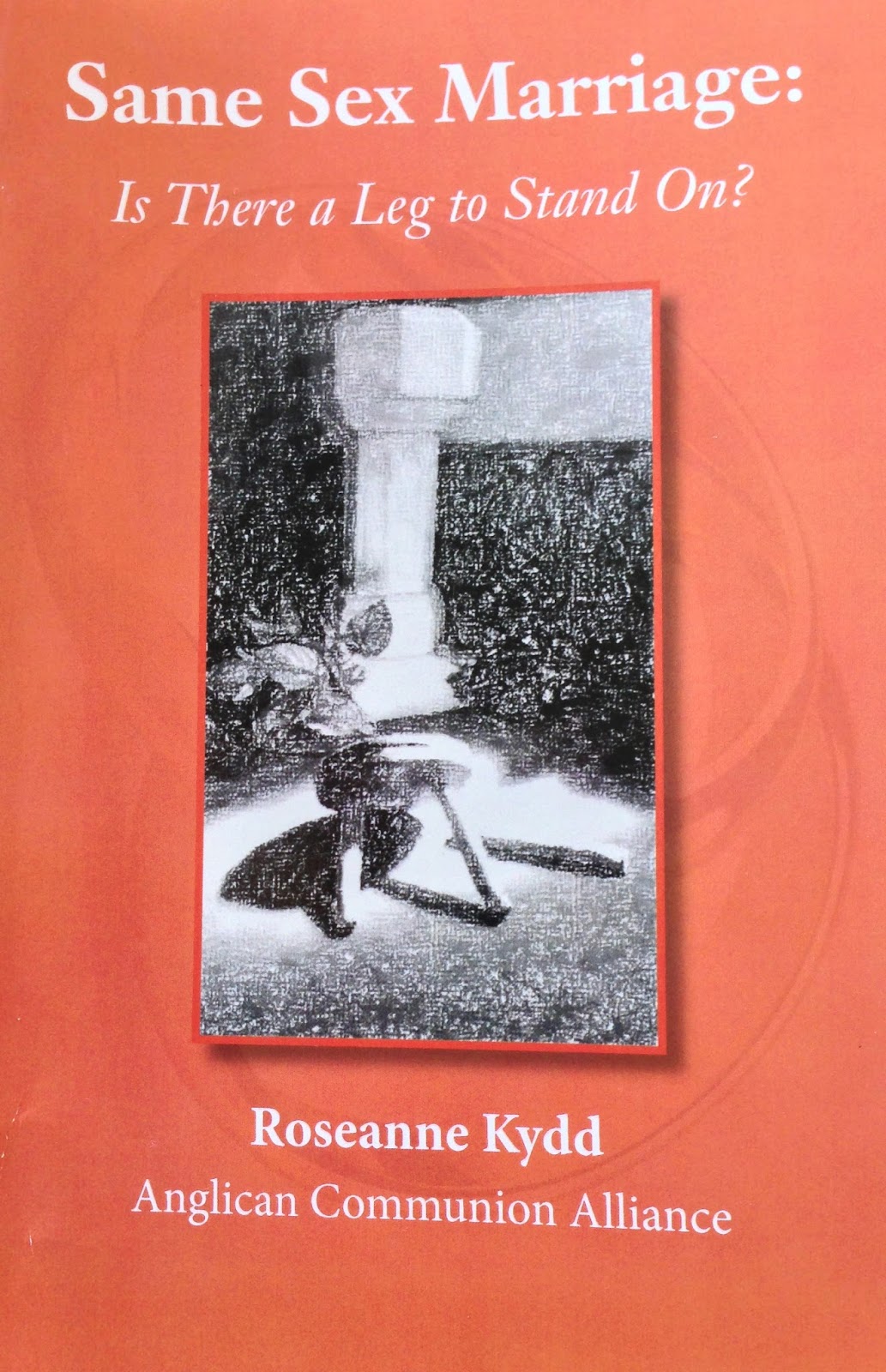
Same Sex Marriage: Is There a Leg to Stand On?—a Review: and Some Other Thoughts on the Matter

I have to confess when I first came across this book at a recent Anglican Communion Alliance meeting, I secretly thought  (sorry, Roseanne), "O, no! Yet another book saying the same things over again!"

Reading it has disabused me of that idea! Roseanne has provided a very readable and fresh treatment of the subject. First, she gives an account of the development of gay and lesbian activism including the move from disorder to not for the American Psychiatric Association and the legal path to same sex marriage in Canada. Then, she shows how discourse around the issue has gone from the language of mere God-given biological sexual identity to that of socially constructed gender and sexual fluidity. Chapter Three explores the potential unintended (and negative) consequences of same sex marriage. In Chapter Four there is a brief account of how activism, gender progress and unintended consequences already have, or may, impact the Anglican Church of Canada. Finally, Roseanne explores the the impact of all this on the classic Anglican three-legged stool of Scripture, tradition and reason—hence the subtitle.

I doubt there are many minds left that are not made up on this subject by now, so why yet another book about it? Imagine my surprise this very morning when I found the answer to that question beautifully expressed in, "A Better Conversation about Homosexuality: three recent books expose the cultural captivity of the church to Western ideas about sexuality," a book review by Christopher Benson over at Christianity Today:
Just at the point of exhaustion and irritability, when we think the debate on homosexuality in the church has reached its end—with every position articulated, every line drawn in the sand, every constituency ghettoized—other voices emerge to remind us that the conversation must proceed. Despite anxiety for ourselves and the church, the conversation must proceed because God has called us to this annoyance as he has called previous generations of Christians to other annoyances; the interpretation of Scripture requires us to think deeply and wait patiently upon God; the shalom of the church is at risk if we close down the search for agreement; and, lest we forget, some of God’s precious children live upon the rack.
Benson goes on to review three new books on the subject (read it all here).

Exhaustion, irritability and annoyance notwithstanding, to me it seems that even as we might be secretly hoping to change a mind or two, before we take this momentous step, it's really important that all the ground is covered and the case is made, as winsomely and biblically as possible, before we abandon historical, biblical, Christian marriage (there, my bias is showing). Roseanne's book is another excellent resource to help us think deeply as we pray and wait upon God.

BUTTERFLIES, BUNNIES AND FLOOD PLAINS

Roseanne's chapter on The Butterfly Effect and Unintended Consequences resonated for me especially.  I was reminded of ELCiC National Bishop, Susan Johnson's comments I read somewhere at the Joint Assembly saying that allowing just same sex blessings in 2011 caused their decline in numbers and finances to accelerate. I know that at least thirty congregations in Alberta left the denomination over it. Although unintended, the consequences can not have been entirely unexpected, I suspect. One can only imagine what the unintended and unforeseen consequences might be if we move to a form of same sex marriage.

I am reminded of other human attempts to "improve" on the way God set the natural world up.  In 1859 a farmer in Australia released twelve rabbits to improve his hunting fun—such a small, insignificant act. The unintended negative consequences were and are catastrophic.  That's just one example. There are many such "improvements" leading to unintended ecological disaster.

The recent flooding in Southern Alberta has generated much talk about the wisdom of building homes on flood plains. The unintended consequences have been grave for many. I wonder if same sex marriage will be like building on a flood plain. At first the setting is most desirable and a delight to the eyes, perhaps the beauty will continue for many years, but one day the natural order God created will kick in and do what it's designed to do and all will be swept away or buried under silt and worse.

Friday, 12 July 2013

More on the General Synod 2013 Marriage Canon Resolution from The Anglican Journal

For some Canadian Anglicans, General Synod’s decision on July 6 to bring to its next meeting in 2016 a resolution changing the church’s law to allow same-sex marriage will bring new life; but others argue it will only serve to precipitate its decline.

All here: Joy, sadness over proposed marriage canon change.

General Synod 2013: Water, the Marriage Canon, Kindness and Severity, Flesh and Spirit, and a Gospel Song


Home from beautiful Ottawa after General Synod (in Joint Assembly with the Evangelical Luther Church in Canada) and an Anglican Renewal Ministries Board meeting. I really enjoyed time spent with Calgary delegates and friends from across the church, both delegates and exhibitors—particularly The Prayer Book Society and The Anglican Communion Alliance folk. 

Some things that stay with me. 


WATER


I was moved by the Right to Water prayers Saturday morning on Parliament Hill. The prayers in my little group of Lutherans and Anglicans from across the land were heartfelt and real. I felt blessed to be one of several hundreds turning in unison to face east, south, west and north as we prayed, in Jesus' name, that our water resources would be protected and available to all who need them. 


THE MARRIAGE CANON

Last Saturday, the following resolution was carried by orders in the General Synod of the Anglican Church of Canada meeting in Ottawa.
Be it resolved that this General Synod 
direct the Council of General Synod to prepare and present a motion at General Synod 2016 to change Canon XXI on Marriage to allow the marriage of same sex couples in the same way as opposite sex couples, and that this motion should include a conscience clause so that no member of the clergy, bishop, congregation or diocese should be constrained to participate in or authorize such marriages against the dictates of their conscience. 
This motion will also include supporting documentation that:
a) demonstrates broad consultation in its preparation;
b) explains how this motion does not contravene the Solemn Declaration;
c) confirms immunity under civil law and the Human Rights Code for those bishops, dioceses and priests who refuse to participate in or authorize the marriage of same-sex couples on the basis of conscience; and
d) provides a biblical and theological rationale for this change in teaching on the nature of Christian marriage.
While I am grateful for the second section which was the amendment proposed by the surprising duo of Bishop Stephen Andrews and Dean Peter Elliot, and appreciate the call for a rigorous biblical and theological rationale before we abandon historical, Biblical, Christian marriage, I continue to be profoundly saddened and disappointed that our Church continues to be so intent on this course. Despite the amendment, I see this resolution as another significant step along that road.

KINDNESS AND SEVERITY

One of the things which makes all this so difficult is that those who want to redefine marriage in this way are doing it out of kindness, so to oppose is to seem unkind. Sometimes my kids thought I was unkind when I wouldn't allow them to do what they wanted to do. In their youth they were unable, or unwilling, to accept that my denying them came out of love. I am far from perfect, but the God and Father of our Lord Jesus Christ, whose Word written we are about to reject, is. He is kind, but he can also be severe. My kids sometimes thought I was unreasonably severe. They were not able to appreciate what I was trying to do when I said "No" to what they wanted to do. Neither am I, or my brothers and sisters who think the Bible's prohibition of sex outside marriage and sex between people of the same gender is unreasonably severe.

In God's kindness and severity we don't always get to do what we want to do, what feels right, or what seems good to us. Whatever our gender or sexual orientation, there's a battle going on over the Bible's authority and trustworthiness regarding sexual morality.

FLESH AND SPIRIT
For the desires of the flesh are against the Spirit, and the desires of the Spirit are against the flesh, for these are opposed to each other, to keep you from doing the things you want to do. (Ga5.16-17)

This is a hard word. It seems unfair. I know that many people who experience same sex attraction did not choose to do so. I know that many love Jesus and truly want to follow him faithfully. I really wish I could say that God says it's good and right in the Bible, but the plain reading says it's not, so I am left in the uncomfortable and increasingly unpopular position of having to say I cannot believe that it's good and right—notwithstanding the arguments in favour coming from such things as Jesus' silence on the matter, questions about the biblical acceptance of slavery, and that we no longer observe such biblical prohibitions as mixing different textiles, eating shell-fish, and divorce.

Sin is crouching at our doors. Its desire is for us. We must master it (Ge4.7).

A GOSPEL SONG


Another highlight for me was the singing of the Gospel during the closing service. I loved the mixture of voices, styles and harmonies worship leader Tim Piper, Charlotte Corwin and the choir provided.

I particularly enjoyed watching those little legs swinging from the snuggly as her (I think) mother (third from the left) sang in the choir. 


Monday, 5 November 2012

Anglican Drift: Canadian Dioceses and Same Sex Blessings, the Anglican Consultative Council and the Bible in the Life of the Church Project


…upset with the continuing drift in the Anglican world. 

Canada 

The Anglican Essentials Canada Blog recently reported that the Diocese of Rupert’s Land has now joined British Columbia, New Westminster, Edmonton, Niagara, Huron, Ottawa, Toronto, Montreal, and Nova Scotia and Prince Edward Island in making the blessing of same sex unions possible. That's a third of the dioceses in the Anglican Church of Canada. 
It seems that in deciding not to make a decision on the matter, General Synod 2010 was not so much allowing time for growing consensus as making the way clear for dioceses to go ahead severally. There has been no intention of holding off for the sake of the communion. It's hard not feel duped. 

The Anglican Consultative Council meeting in NZ

Things are not much better on the international level. Canon Phil Ashey, Chief Operating and Development Officer for the American Anglican Council writes: 
In terms of what seems to be emerging, I would respectfully suggest the following as a “pincer” movement that ACC/ACO is going to place upon confessing Anglicans: 
1. Through Continuing Indaba dialogue and stories, bolstered by the work of the Bible in the Life of the Church (BILC) resources, Biblical interpretation of human sexuality and its limits will be rendered value-neutral with no limits on Biblical interpretation within the Communion. Lambeth 1.10 will be declared in effect non-binding; 
2. Then, through the new Code of Conduct and the Safe Church resolution, any objection to sexual expressions that are not Biblical will be deemed “harassment,” chilling any speech and bringing consequences to those who, in Anglican communion meetings, dare to raise the subject. 
I pray I am mistaken, but that is my best look into the future. 
…also from The Anglican Essentials Canada Blog and just as disturbing. 

Bible in the Life of the Church

There was a report from the Bible in the Life of the Church project at the Anglican Consultative Council meeting in New Zealand. Why do such projects so rarely call for deeper submission to Scripture in the Anglican world? On the contrary, the authority and reliability of Scripture is constantly called into question. Personal experience, a culture of victimhood and postmodern progressive cultural mores trump the Scripture every time.  

Anglican Down Under comments on the Anglican Consultative Council and the report:
if its celebration of the report on the Bible in the Communion is a guide, any time there is disagreement about truth, we celebrate our diversity instead of mourning our loss of unity. Such response is scandalous, a stumbling block to true Christian "progress"…
Celebrating diversity constantly is a shell game, an avoidance of the hard work finding the truth involves. The point of theology is to seek truth. Stopping when the going gets hard with a celebration of diversity of viewpoint is intellectual laziness. We will only progress as a Communion when we repent of our apathy and move forward zealous for the truth.
But then, there's no longer such a thing as objective truth. All is relative.

Anglican Down Under, also shared this comment on the project: 
After three and half years of worldwide research, the Bible in the Life of the Church project has found that Anglicans around the globe share “a high common ground” over the essential place and use of the Bible in Anglican life. 
How can a communion which can't agree on whether it is even God's Word possibly have a "high common ground"? And that's before we get onto interpretation, criticism, contextualisation etc. The authors appear to have done a thorough job in their research, but it doesn't seem to pass the common sense test. Why is our communion falling apart if we all agree on our foundational text and its meaning for us today?
To me it always feels like the truth of Scripture and the importance and uniqueness of Jesus as Saviour is always being called into question and watered down. I continue to be saddened by it all.

Monday, 16 July 2012

The Anglican Mess: Kiwis, Yanks, Comprehensiveness, Liberal Theology and the Bible

Both New Zealand's General Synod and The Episcopal Church's General Convention have just taken place. The Kiwis and Polynesians have decided to study the theology of marriage with a view to somehow "progressing" beyond the merely heterosexual. The Episcopalians have approved a rite for blessing same-sex couples and have decided that transgender issues may not inhibit a person from leadership in the church and ordination. There are plenty of Canadian Anglicans who want to go there, too—several dioceses already have.

There has, of course, been considerable commentary on it all. For example, Anglican Down Under (ADU) who works for Bishop Victoria Matthews and the Diocese of Christchurch, feels that these developments threaten the comprehensiveness he believes has been the Anglican advantage up to now:
Personally I would be deeply saddened to find that the comprehensiveness of the church to which I belong, through birth, baptism, conviction and license, is jettisoned. But worse, I see signs that it would be the beginning of the end of this church. As Anglicans used to being the largest and greatest church of the land, we can miss seeing the bigger picture of contemporary Christianity in these islands. In that bigger picture we are increasingly a smaller player. The growth areas in congregational life are in churches of other denominations and even of no denomination. Anglicanism could disappear tomorrow off the face of New Zealand's earth and Christianity would continue to thrive, grow, permutate and develop. In particular, Christianity of the non-Anglican variety is showing itself as particularly adept at winning young people to Christ. And, guess what, most are joining up to a discipleship programme which is not liberal/progressive. 
I see a huge temptation in the GS of 2014 to determine that when most of the rest of Christianity in Aotearoa New Zealand is conservative, traditional, biblical in its orthodoxy and orthopraxy, ACANZP can become the liberal/progressive alternative. My prayer, wish, agenda and campaign here (for what it is feebly worth) is that our church does not take that turn, but determines, whatever re-examinations take place in the next two years, that we will both remain a comprehensive church and be part of the mainstream future of Christianity in these islands.
In that same post (all here) ADU also refers to a New York Times piece on the subject: "Can Liberal Christianity Be Saved?" in which one, Ross Douthat, comments on the headlong Episcopal push to progressive-liberal theology:
Yet instead of attracting a younger, more open-minded demographic with these changes, the Episcopal Church’s dying has proceeded apace. Last week, while the church’s House of Bishops was approving a rite to bless same-sex unions, Episcopalian church attendance figures for 2000-10 circulated in the religion blogosphere. They showed something between a decline and a collapse: In the last decade, average Sunday attendance dropped 23 percent, and not a single Episcopal diocese in the country saw churchgoing increase. 
Traditional believers, both Protestant and Catholic, have not necessarily thrived in this environment. The most successful Christian bodies have often been politically conservative but theologically shallow, preaching a gospel of health and wealth rather than the full New Testament message. 
But if conservative Christianity has often been compromised, liberal Christianity has simply collapsed. Practically every denomination — Methodist, Lutheran, Presbyterian — that has tried to adapt itself to contemporary liberal values has seen an Episcopal-style plunge in church attendance.
All here.

There's more! ADU puts his finger the underlying and real issue behind and through it all in another post entitled "Let's change the Bible. No, let's silence it!"

It's a fine mess we've gotten ourselves into, Ollie, and that's a fact!

Friday, 2 March 2012

Same Sex Marriage: Pro and Con Arguments That Made Me Think

Fascinating distillation of arguments for and against same sex marriage from Richard Beck over at Experimental Theology:
This was my argument for the position that, no, same sex marriages are not reflective of the image of God:
Same sex marriages are not in the image of God because when God created humanity in God's image Genesis 1.27 says "male and female he created them." Thus, the model for marriage is Adam and Eve. The basis of marriage is biological complementarity. This understanding is supported in Romans 1 where Paul describes same sex relations as "unnatural." In light of this, the command God gives to marriage, as a reflection of God's image, is reproduction ("be fruitful and multiply"). Obviously, same sex marriages are not based on biological complementarity and cannot procreate. Thus, same sex marriages cannot reflect the image of God. The theology informing this understanding is creation theology.
This was my argument for the position that, yes, same sex marriages are reflective of the image of God:
Same sex marriages are in the image of God because the model for marriage is Yahweh and Israel rather than Adam and Eve. Thus, the basis of marriage is grace and election, God choosing Israel from among the nations. The primacy of election/grace over biology is supported in Romans 11 where God is found "unnaturally" grafting the Gentiles into the covenant with Israel. In light of this, the command God gives to marriage to reflect God's image is covenant faithfulness. Obviously, same sex marriages display the grace of election and can model covenant faithfulness. Thus, same sex marriages can reflect the image of God. The theology informing this understanding is salvation history.
…all here. I appreciate his reasoned, balanced, un-shrill approach. Not surprising, I suppose, since he was debating himself.

Personally, I still find the "no" argument more compelling. I have not seen this particular "yes" argument before. In my opinion, it's better than the-Bible-doesn't-really-say-that argument but it's still reaching further than I think is reasonable.

Monday, 15 October 2007

Ottawa Synod

So the Diocese of Ottawa has moved closer to the precipice with same sex couples and marriage. LORD, have mercy. See the Anglican Journal story here.

The last General Synod resolution claiming that the blessing of same-sex unions is not in conflict with the core doctrine of The Anglican Church of Canada opened the door. If it is not in conflict, why not go ahead? After all, the same General Synod only narrowly defeated the resolution affirming the authority and jurisdiction of any diocesan synod, with the concurrence of its bishop, to authorize the blessing of committed same sex unions. Besides, New Westminster got away with it. At the moment, there is no real way to discipline such actions.

I voted against both motions; the first because I believe SSBs are in conflict with core Christian, if not Anglican, doctrines of Creation, and the Nature of Men and Women; the second because diocesan synods do not have the authority to go against the clear teaching of Scripture.

This is simply, tragically wrong.

The Synod of the Diocese of Montreal is about to meet and consider the same resolution.

Christ, have mercy.

Saturday, 12 May 2007

Interview with Charlie Masters, Anglican Essentials Canada National Director

In an interview with the Toronto Star, Charlie Masters, the National Director of Anglican Essentials Canada, is quoted as saying:
If same-sex blessings are approved, the church will effectively be saying it no longer wants to be part of the worldwide communion, says Masters, whose parish voted to split with the Canadian Church if the resolutions pass.

"It seemed to us it was important to demonstrate how serious we felt this was, by saying, `You know what, if you go this way, if you walk apart, some of us won't be walking with you.'"

More than a dozen congregations have made a commitment to Essentials, with more considering the move.

If that happens, Essentials will ask the archbishop of Canterbury to recognize them as the legitimate church in Canada.
Read it all here.

The Canadian House of Bishops Statement to which he refers is here.

I don't want to be in a church that walks apart from the Anglican Communion.

Saturday, 18 March 2006

X Marks the Spot: Alberta Checkboxes for Brides and Grooms

Got to preside a wedding today. I always enjoy them.

I was surprised how sad I felt, however, when I noticed at the rehearsal that the Alberta Government Services Registries form has been changed. Now, under both Groom and Bride there is a checkbox for male and female.

Lord, have mercy.


2 comments:

Chip Johnson+, cj said...
Well, you knew it was coming, after the laws changed last fall. Which box did you check at which name? (chuckle!)

Pax Christi †,
Br Chip
Peter said...
Just waiting for the other checkboxes - Non-Human, Non-Sentient etc......