Showing posts with label I'm an Anglican and I'm Okay. Show all posts

Monday, 9 March 2015

Lent-ward Leaning

I decided to keep giving up working for a living for Lent this year. It's going well. I really like it. The observing a Holy Lent stuff fits: self-examination, penitence, prayer, fasting, almsgiving and reading and meditating on the Word of God. Here's how.

Self-examination

I've done little else since I retired. Feeling it. How is my post parish ministry sabbatical year life serving God, if at all? It just feels so good! And why should I get to enjoy so much goodness when others have had to suffer so for their faith, especially in the Middle East recently? 
     I haven't missed presiding and preaching yet. I appreciate that I got to do it for a time, but retirement feels like a new thing for me. I've entered a new space. It reminds me of the big change from television directing to seminary and ministry in the late 80s. I was grateful for the TV years, but I didn't miss them though seminary and the early parish priest days until one day when I came across a crew shooting something in the foothills south of Calgary, one of whom was a sound guy with whom I used to work. That must have been five or seven years after the change. I felt a pang and a sense of loss, but not for long. Maybe I'm just slow. But I didn't want to go back. 

Penitence

I continue to be a thoroughly competent sinner in retirement. My self-examination reminds me of the selfish motives behind much of what I do and did as a parish priest—ambition, drawing attention to my abilities and talents—the list goes on. I have been reminded of how little I achieved that is measurable. Not that it was nothing. The LORD worked through me and the people I served in ways noticeable and not. So, penitence in retirement means I also, when I look back at what I've done, cannot say more than what Jesus suggested in Luke's gospel: "I am an unworthy servant; I have only done what was my duty" (Luke 17.10)—for some of the time, at least. My boat is so full of goodness, I am also reminded of Peter's words to Jesus, "Go away from me for I am a sinful man." (Luke 5.8)

Prayer

Anglican liturgical prayer in particular. I love leisurely Morning Prayer with Jude and a cup of coffee. I've enjoyed the time to pray Evening Prayer and Night Prayer, too. Rich. Especially this Lent. We've decided to use the traditional language CofE Daily Prayer app. The Canadian Book of Common Prayer was my introduction to Anglican daily prayer back in the 80s. I prayed through it thoroughly. The lectionary, the PRAYERS AND THANKSGIVINGS UPON SEVERAL OCCASIONS, the FORMS OF PRAYER TO BE USED IN FAMILIES. I prayed them all. Systematically. All 46+9 of the PRAYERS AND THANKSGIVINGS. I loved it. As a result, I got to know it pretty well. Praying it again this Lent is reminding me of those days of discovery. 
     The language is a treat. The LORD shews stuff, things are forgat withal, some women are strange, we are a thoroughly froward lot exhibiting all kinds of naughtiness all over the round world. We ought, therefore, and with haste, gat ourselves to the Lord, and that right humbly lest we be minished.
     The words have a certain Lenten grittiness and the liturgy is just as Sister Monica Joan said in Call the Midwife…


…happily clinging still, and that right happily. 

Fasting

Not so much other than on Ash Wednesday so far. Retirement has been more a feast than a fast. 

Almsgiving

Some opportunities. Here's a good one for Lent—or any time of year, for that matter—women in need of obstetric fistula repair. 

Reading and Meditating on the Word of God

My next post, LORD willing…


Sunday, 25 January 2015

On the Merits of Liturgy and the Church Calendar

I've written about liturgy before. Here's another lovely take on it:
Liturgy, at its best, is more like the tracks of the train than the whistle. It’s silent and sturdy and, though almost unnoticed, it leads us to where our hearts long to go. In perhaps the most quoted address on liturgy, C.S. Lewis states, that liturgy is most useful “when, through long familiarity, we don’t have to think about it. As long as you notice, and have to count, the steps, you are not yet dancing but only learning to dance. A good shoe is a shoe you don’t notice. Good reading becomes possible when you need not consciously think about eyes, or light, or print, or spelling. The perfect church service would be one we were almost unaware of; our attention would have been on God.
…from Tish Harrison Warren, a priest in the Anglican Church in North America, in a piece on her discovery and appreciation for the church calendar in Christianity Today's excellent "Her.meneutics" here.

Liturgy's trustworthy tracks, along with the church calendar, keep our worship and personal devotions on course as, year after year, they carry us along through the story of Jesus from Advent through Easter and a focus on discipleship for the rest of the year. The accompanying lectionary ensures that we are all, including preachers, at least exposed to themes with which we might not otherwise be inclined to engage.

Sunday, 18 January 2015

One Side to the Other: New Beginnings and Thoughts on Worship


This morning the missal stand (which holds the big prayer book at a convenient angle from which to read on the altar) had been moved from one side of the altar to the other at StB. I noticed it as soon as I settled into my pew. 'Tis an outward and visible sign of the fact that we now have a new presider. This next stage of our journey to meet Jesus when he comes again has begun. Our new and very welcome priest, The Rev Dr Dustin Resch, now has the con. This morning he presided and preached (praught?) for the first time. It was grand. 

Keep Calm and Worship On

Here are some thoughts and discoveries about worshipping on the other side of the rood screen (supposing we had one) from that most peculiar and sometime irksome personage; the previous rector. These have been bubbling up and mouldering as Jude and I wandered at first without benefit of flock in the early months of retirement and more recently when it felt right to return to StB.

All Circumstances

Rejoice always, pray without ceasing, give thanks in all circumstances; for this is the will of God in Christ Jesus for you. (1 Thessalonians 5:16–18 ESV)
What we Anglicans (and Roman Catholics and most Lutherans, too) do most Sundays is celebrate Eucharist (more on that later). The word comes from the Greek word for thanksgiving. As as lover, follower and worshipper of the God and Father of our Lord Jesus Christ I ought to be able to give worshipful thanks for what God has done, is doing and will do, in all circumstances—especially on Sunday mornings at church no matter where I am, who is presiding, how loud the children are, whether or not I like the music, or denominational peculiarities, or style, or the people up front, or around me. This was impressed upon me especially during our wanderings. I was reminded that I have a job to do among God's people at worship wherever I go. My job is to apply myself to the task, or the work, in liturgical terms (the word liturgy means work of the people) allowing nothing to distract me. In all circumstances. It is my responsibility. If I let some real or imagined failing of a leader or anyone else deflect me, the devil wins. If something bothers me, I just have to work harder. Sure, my mind wanders. Less often than it used to, perhaps. If it does, I just catch myself and refocus on what's being said, sung and prayed. Over and over again, as necessary.

Bible Delight

I love the Bible. I love the way we hear three passages read aloud every Sunday. I believe God's written Word read out loud gradually salts us through and through so it will not return to Him empty. It will succeed in the thing for which He sent it (Isa 55.11). 

When I led worship from the other side of the rood screen, I used to encourage people to bring their Bibles to church so they could follow the readings. I thought that doing that helps us learn where things are in there. I used to feel a little impatient with people because most didn't. On this side of the screen I find myself repenting of that. I find that I don't want to read along as the passages are read, I'm enjoying listening to them. I have to concentrate. My monkey-mind can head off on tangents very easily. But I find watching the face of the reader helpful in listening deeply. I've seen some folk close their eyes to listen, but I find the watching helpful for some reason. 

I still have my Bible handy in some form in case I need to look at a phrase or a verse more closely and I think daily Bible reading in the context of The Daily Office (Morning and Evening Prayer) is important to help keep my faith and spiritual self alive, but Sunday listening has been the thing for me—somewhat to my surprise.

Worship in Song

Sometimes when I don't know a song I'm tempted to zone out and wait until it's over. But if All Circumstances above is valid, there are several ways I can be a part of the worship at all times. For example: 
  1. I can silently pray the lyrics as those who know the song sing
  2. I can harmonize by quietly singing or reciting appropriate Bible verses, for example, "How glorious you are, more majestic than the everlasting mountains!" (Ps 76.4) or "Be exalted O Lord above the heavens, let your glory be over all the earth!" (Ps 57.11) or I can pray "Glory to the Father, and to the Son and to the Holy Spirit, as it was in the beginning, is now and ever shall be, world without end!" Watch for verses you can use in this way in your daily Bible reading. 
  3. I can harmonize by singing in the Spirit as I pray in tongues (1 Cor 12.10) if I have that gift.
There is no reason why I should allow myself to be left out of the worship whether I know the song or not or how well it is led.

Making Eucharist

I love the drama of the Lord's Table. The story of our salvation is told Sunday after Sunday. The bread and the wine are presented, prepared and prayed over. The Lord is remembered until he comes again. I enjoyed presiding, but I also now love being a part of the parade of humanity that goes up to receive what Jesus has provided; old and young, male and female, all shapes and sizes, Sunday by Sunday; we approach, receive and return; a graceful altar call and response. I miss it whenever we're away, but I can still worship when I put my mind to it. 

The most important thing is that the God and Father of our Lord Jesus Christ is worshipped and enjoyed in the power of the Holy Spirit no matter what and in all circumstances. 

It is SO good to be home.

Thursday, 20 November 2014

A Delicate State: Thoughts Arising From Archbishop Welby's Address to the CofE's General Synod

Recently I read The Anglican Communion's Challenges and The Way Forward, Archbishop of Canterbury, Justin Welby’s address to the Church of England General Synod. Anyone looking for a magic bullet to solve all our problems, toss out the bad guys and make everything better will be disappointed. Instead, the Archbishop acknowledged that we are “a flourishing Communion but also a divided Communion” and that he is "utterly daunted by the differences that exist. They are huge,” and “our divisions may be too much to manage.” No rose-tinted spectacles there or here:
In many parts of the Communion, including here, there is a belief that opponents are either faithless to the tradition, or by contrast that they are cruel, judgemental, inhuman. I have to say that we are in a state so delicate that without prayer and repentance, it is hard to see how we can avoid some serious fractures.
To resolve the issues we face
is almost unimaginably difficult, and most certainly cannot be done except with a whole-hearted openness to the Holy Spirit at work amongst us. It comes with prayer, and us growing closer to God in Jesus Christ and nothing else is an effective substitute. There are no strategies and no plans beyond prayer and obedience. 
Prayer, repentance and obedience. I can’t argue with that. The trouble is I’m inclined to think it’s the people I believe are in error that need to pray, repent and obey the most. And then, what if I’m right? Or, is it remotely possible that I’ve been log-blinded and am wrong? How then shall I behave? Archbishop Welby again:
…the future of the Communion requires sacrifice.  The biggest sacrifice is that we cannot only work with those we like, and hang out with those whose views are also ours.  Groups of like-minded individuals meeting to support and encourage each other may be necessary, indeed often are very necessary, but they are never sufficient.  Sufficiency is in loving those with whom we disagree.  What may be necessary in the way of party politics, is not sufficient in what might be called the polity of the Church. 
Even when we feel a group is beyond the pale for its doctrine, or for its language about others or us, we must love. Love one another, love your neighbour, love your enemy. Who in the world is in none of those categories?
Sacrifice and love. As Jesus did, Welby covers the all love bases: one another, neighbour and enemy. No loop-holes there. Then
underpinning us is a unity imposed by the Spirit of God on those who name Jesus Christ as Lord and Saviour.
A unity imposed by the Holy Spirit. Can withdrawal from relationship or schism be imposed by the Holy Spirit? Paul calls the Corinthians not to be unequally yoked with unbelievers, to go out from them and be separate (2 Cor 6:14-17) but when we think believers are in error, what then? Might something like Paul's instructions to the Thessalonians apply?
If anyone does not obey what we say in this letter, take note of that person, and have nothing to do with him, that he may be ashamed. Do not regard him as an enemy, but warn him as a brother. (2 Thessalonians 3:14–15 ESV)
I am reminded of Prime Minister Harper's recent treatment of Russian President Vladimir Putin at the G20 summit: "I guess I'll shake your hand, but I only have one thing to say to you: you need to get out of Ukraine." Would our equivalent be, "I'm obliged to love you (agape, not phileo), but I have this to say to you, you need to stop/get out of/ repent of thus and so?" This after considerable self examination with prayer and repentance, an honest and sacrificial commitment to obey Scripture and to love the persons with whom we disagree.

More than almost unimaginably difficult, perhaps. Yet, we live and move and have our being in a world where a virgin gave birth to son who was subsequently raised from the dead. I don't understand how the God and Father of Our Lord Jesus Christ did that any more than I can see how he might hold the Anglican Communion together in a way with which all parties can live and enjoy, but I know he is capable of much more than my puny mind can ask or imagine. And a good thing, too.

Monday, 21 April 2014

Collared: the Full Easter


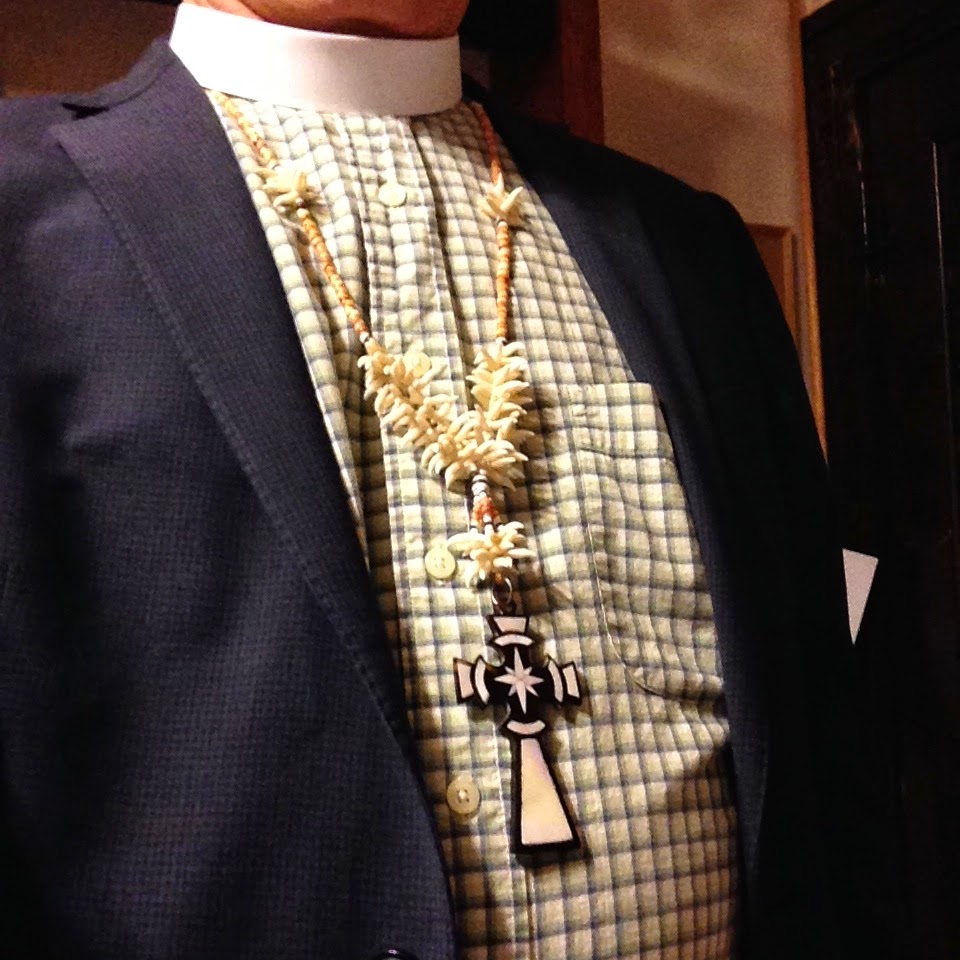
My Easter and Christmas rig. Jude chose the shirt at The Vill-a-a-age, took the collar off and made provision for the collar studs (thank you, my dear). Bit over the top for normal wear for me. But then being raised from the dead is pretty well over the top, too. Worthy of a shirt with a little extra pizzazz. 

The cross was a gift from The Reverend John Falea of the Solomon Islands. We were class mates at seminary. Those are real dolphin teeth, the "beads" are shell money, the cross is turtle shell with mother of pearl inlay. John's father made it. Thoroughly appropriate for a gospel with sharp teeth that is an absolute treasure. Resurrection and Incarnation worthy wear, indeed. 

I have at least one dear Anglican priest friend whose "inner Pharisee" might stir at the sight of such clerical irregularity. But, since He really is Risen Indeed and a whole world of natural and rational rules and laws were broken in the rising, a little celebratory sartorial boundary pushing can't hurt. Besides, what can they do? Fire me?

One of these days I hope to write some more in my "Retirement and Things I Would, or Would Not, Do Differently" series about wearing clerical collars or not, among other things. I think I'll call it Collared: Confessions of an Introverted? Ordinary? Anglican Clergyman—or something like that. 


Saturday, 19 April 2014

On Doing Holy Week Anglicanly: More on Retirement and Things I Would or Would Not Do Differently

The best Easters I’ve experienced have always followed a fully observed Holy Week. Palm Sunday, Monday, Tuesday and Wednesday in Holy Week, Maundy Thursday, Good Friday and The Great Vigil of Easter on Holy Saturday. I’m usually thoroughly weary by Easter Sunday morning, but does it ever light up. Taking the time to follow Jesus on his journey through that last week makes it real and rich. We don’t even do anything particularly creative. Just the liturgies as they appear in The Book of Alternative Services straight up and unadorned. It just works.

Lately, we’ve not observed the Mondays, Tuesdays and Wednesdays. When we did—and they helped deliver the best Easters—we would do an early morning Eucharist on Monday with Evening Prayer and even Compline some years, followed by Morning Prayer on Tuesday morning, a Eucharist at noon and Evening Prayer, and then Morning Prayer and a Eucharist around supper time on Wednesday. We did it that way so as many people as possible could experience as many liturgies as possible. It was rich.

Maundy Thursday has always included foot washing exactly as laid out in the book. I’ve never organized anyone to come to have their feet washed before hand. Some always come. We’ve also provided a couple of stations for people to wash one another’s feet. It is so moving to see grandchildren washing their grandmother’s feet and vice versa—wives and husbands, friends. We acknowledge this day is so named because of Jesus’ new commandment (latin: maundate) to love one another. We give thanks for the institution of the Eucharist. Afterwards, the altar is stripped and all the decorations and colour are removed as the lights are extinguished. We depart in silence. It never fails to move me.

Medicine Hat Good Friday’s have always begun for me with the Evangelical Association service in the morning—an extroverted, high energy affair with close to two thousand souls present every year. To miss that out of Anglican liturgical sensitivity would be wrong, especially when I know I can also indulge my Anglican quietism in an hour of silent meditation on The Stations of the Cross in the church in the afternoon before The Celebration of the Lord’s Passion—again, straight out of the book. It’s quiet, holy and lovely.

And then The Great Vigil of Easter on Saturday. We do it at sundown. This year that means 822pm. We light the new fire, process into the darkened church behind the Pascal Candle. Candles are lit and the Exultet is sung as the church is redecorated with hangings and Easter lilies. We listen to lots of Scripture (thirteen readings!) telling the story of our Salvation, we baptize people or re-affirm our baptismal vows and we celebrate the Eucharist. Sometimes we roast marshmallows over a re-kindled new fire out behind the hall afterwards. It’s wonderful.

Finally, it’s Easter morning. Jesus Christ is risen today! Lively. Joyful. All the more luminous because of the quiet, darker days before.

I’m a soon to be retired Anglican priest and I’m okay.


Saturday, 1 March 2014

On Retirement and Things I Would or Would Not Do Differently

As retirement approaches I find myself wondering about what I think I’d do differently if I were starting out again.

One thing I wouldn’t change is being Anglican. I love the way we worship. I love the theatre of it, the drama, the colours, the visuals and the way the divine narrative is covered year after year whether we want to, or not. I love the amount of Bible in it; read out and set to prayer. I love the way it’s always all about Jesus. It picks me up and carries me along no matter how I’m feeling or how engaged I am.

As always, Matt Marino, Episcopal priest in Arizona, puts it well when he describes how Anglican worship works in one of his The Gospel Side blog pieces: To Donald Miller and anyone else considering dumping church: The church works best when you like it least, in which he quotes another Arizona Episcopal priest, Gil Stafford:
The liturgy is like a rock falling into a stream. It rubs the rough edges off of us week after week, year after year. It is an infinitely slow and quiet transformation that is about being with other rocks in the stream as the Spirit works through the years, the prayers, the Sacraments and the community of faith. 
I love it all; the daily offices, the church year, the chanting, the bread and the wine each Sunday. I love the traditional prayer book worship in Shakespearean language and the contemporary rites according to our rather gracelessly entitled Book of Alternative Services. I love the routine, having to resist ennui, the cycle of the church year, the politically incorrect Scripture passages that slip through on Sunday mornings despite attempts to protect our delicate Anglican sensibilities. I love the Englishness of it and having to abide by the pastoral direction of a bishop. I love the way the liturgical system draws me into something much bigger and older than me. I have to serve it. It is not there to serve me and meet my needs.

Marino describes it in a rather lovely Eugene Peterson-esque way, also in the aforementioned post:
It is a long obedience in the same direction. It is about consuming Jesus and being consumed by him. And, I am convinced, the church works specifically best when we do not like it! When we choose to engage and to cooperate with the prayers, and surrender to the Lord of the prayers, and come, kneel, reach out our hands and receive, and “taste and see that the Lord is good,” then we truly worship.
It works best when I don’t like it. It works best when it doesn’t feel as if it’s meeting my needs or feeding me. I like the awkwardness and real-ness of that.

I’m a soon to be retired Anglican priest and I’m okay.

Tuesday, 27 July 2010

Being Denominational in an Anglican Way

From time to time Jude and I have become dissatisfied with the Anglican Church. We don't like the way it's losing its Scriptural and doctrinal moorings and we murmur to ourselves. Not a smart thing to do historically—see Dt 1.27, Josh 9.18 and Ps 106.25.

The fact is God chose exactly where and when Jude was to be born as an Anglican and that I would marry her and become an Anglican priest for this particular time in this particular place. He knows exactly what He is doing. Blessed be the Name of the LORD.

So, the front page of June's Christianity Today—"Are Denominations Dead? (Not Quite.)" caught my attention. I read Ed Stetzer's excellent article, "Life in Those Old Bones: if You're Interested in Doing Mission, There Could Hardly Be a Better Tool Than Denominations" in which I found this:
To paraphrase Churchill's comments about democracy: Denominations are the worst way to cooperate—except for all the others. They are riddled with weak, ineffective, and arrogant leadership, prone to navel-gazing, and often move more slowly than they should. But these aspects are products of human fallibility and sin. Every time churches work together, ego, failure, and inefficiency will arise. And when they don't work together, ego, failure, and inefficiency will arise. People, not denominations, are the source.
Denominations at their best are not places to get something but places to give and to serve. Our gifts, passions, and experience have greater influence through a worldwide denominational network. Through a denomination, we can provide resources to people we will never meet, reach places we will never go, and preach the gospel to lost souls who are beyond our personal reach. We can find what we need and give as much as we want—because the key to cooperation is to both give and receive. (All here.)
So Anglican is the worst denomination, except for all the others. As someone said when asked which is the right denomination, "None of them. They're all wrong!" Glad to be Anglican.

Thursday, 11 February 2010

CofE Resolution in Support of the Anglican Church of North America(ACNA)

If you haven't seen it yet, here is the text of the resolution:
That this Synod, aware of the distress caused by recent divisions within the Anglican churches of the United States of America and Canada
a) recognise and affirm the desire of those who have formed the Anglican Church in North America to remain within the Anglican family
b) acknowledge that this aspiration, in respect both of relations with the Church of England and membership of the Anglican Communion, raises issues which the relevant authorities of each need to explore further; and
c) invite the Archbishops to report further to the Synod in 2011
Votes for 309, against 69, abstentions 17
Motions to pass to next business and to adjourn the debate were lost.
Notice that Canada is included. There's a ton of comment all over the blogosphere, but I like David Virtue's take:
First of all, the resolution said orthodox Episcopalians are indeed being persecuted by revisionists; however much TEC leaders whine that the brokenness is caused by those leaving, the resolution says otherwise.

Secondly, the resolution said that these faithful orthodox Anglicans want to remain in the Anglican family and not become outsiders. In fact, it did more than that. It was a wedge that will, in time, lead to a full chair at the Anglican Communion table.
…the rest of David's piece here.

Wednesday, 3 February 2010

Sabbath Interesting Bits: Anglicanism, Marriage, Leadership and theCovenant

My Sabbath is on a Wednesday this week. Some interesting bits from my blog reading this morning:

More Anglican good news

…this time from The Rev'd Dr. John W. Yates II who lists the good things about Anglicanism. At its best, Anglicanism:
  1. is Biblical
  2. is Sacramental
  3. is Evangelical
  4. is Liturgical
  5. is Worldwide
  6. is Charismatic
  7. is about Accountability (we have bishops)
  8. is Musical
  9. Engages society and the world us
  10. is Prayerful
  11. is a Community of Grace
  12. loves Children
  13. loves Beauty
All here (H/T VirtueOnline).

What Marriage and Leadership Have in Common

In our Sabbath devotional this morning, Jude and I read this:
Contrary to hundreds of Hollywood romance movies, marriage is not primarily designed to make us happy. God is not primarily interested in our happiness, but in something deeper and more lasting: our holiness. Or we might say that God is so interested in our long-term happiness — our eternal joy, which only holiness leads to — that he reserves the right to sacrifice our short-term happiness to ensure we receive it.
Ditto for leadership. Kevin Miller, here.

The Anglican Covenant

The excellent ANGLICAN DOWN UNDER has a good point about the living with an Anglican Covenant and whether or not it can work:
Is homosexual practice compatible with Scripture? Some say No, some say Yes. But together we have not yet agreed to one of two things which would accord with a common approach to truth: either that it does not matter if an open contradiction on this matter is a feature of Anglican life, or that it matters that there is an open contradiction but nevertheless we can live with the contradiction.
That's the question. Wise Kiwi. All DOWN UNDER here.

Saturday, 2 January 2010

Happy New Year

This post didn't happen yesterday because we were driving through the blizzard between here and Swift Current (twice!) to give the granddaughters back.

Come and See Evangelism

I can't think of anything deeply theological to write, but my Morning Prayer reading this morning was from John 1 where Nathanael says, "Can anything good come out of Nazareth?" Many are asking the same question about the Anglican Church.
Philip's answer to Nathanael was a simple one and a good one: "Come and see," he said. It's a response many Anglican parishes and individuals can, and should, still say often, and with confidence.

A Bit of Fluff

Jude got a new NZ lambskin steering wheel cover for her beloved red Neon, Cloe, for Christmas.

It's a bit like driving a bedroom slipper. Cosy, though.

A New Bishop

Fraser Lawton is being consecrated Bishop of Athabasca this evening. A good one. God bless him and his family.

Saturday, 19 December 2009

Anglican Communion Covenant Digest for Today

A good discussion and summary with links over at the excellent and thoughtful Anglican Down Under here.

The thing that lit up for me in it all was this from the "Covenant Working Party Commentary on Revisions to Section 4:"
If, however, the canons and constitutions of a Province permit, there is no reason why a diocesan synod should not commit itself to the covenant, thus strengthening its commitment to the interdependent life of the Communion.”
Let's get at it!

Tuesday, 17 November 2009

Out of Silence

I'm on retreat at Mount St Francis in Cochrane, Alberta; my eighteenth Diocese of Calgary clergy retreat here. Other than in our worship and our retreat leader's words (National Indigenous Bishop Mark MacDonald) we are silent from just after lunch on Monday to after the Eucharist just before lunch on Thursday.

I love it.

Mind you, it isn't really silent. It's amazing how much noise we make even when we're not speaking; footsteps seem heavy, whispers seem very loud, water runs, toilets flush, the retreat centre phone rings and is answered. But I don't have to talk to anyone, even at meal time. I love it.

The only words I say are words of worship in the daily prayer and Eucharist.

I read and think and pray and write and listen. The silence makes room for the Lord to download some stuff if he wants. I don't necessarily know what yet, but I know from experience that there's new material aboard and it will pop up when I least expect it and at exactly the right time.

Tuesday, 27 October 2009

On Being Christian, Anglican and Evangelical: in That Order

Anglican Down Under quoting The Ugly Vicar quoting Bishop Stephen Neill in a post on being Christian, Anglican and Evangelical; in that order:
Show us anything clearly set forth in Holy Scripture that we do not teach and we will teach it. Show us anything in our teaching or practice is clearly contrary to Holy Scripture, and we will abandon it. (Anglicanism, Pelican Books, 1965, p 417)
Good stuff. All here and here.

Monday, 26 October 2009

David Warren on the Roman Catholic Cat Among the Anglican Pigeons

The Ottawa Citizen's David Warren has weighed in on all the commentary and opinion arising out of the Roman Catholic invitation to traditional Anglicans. He makes a point which I have not yet seen in all the debate—the possible benefits for the Catholics:
the reception of these traditional Anglicans will create very exciting possibilities for all English-speaking Catholics on the "liturgical" front: for the traditional Anglicans retain, in intensely beautiful English, a liturgy that is actually more "catholic" in spirit and form than the rather crass and now dated "contemporary translations" Rome mistakenly approved at the end of the 1960s, in the depths of the post-Vatican II meltdown. Those old Anglicans can help us recover our own more reverent liturgical traditions.
…one answer, and a good one, to the question: Can anything good come out of Anglicanism?

I'm happy to say we get to enjoy that intensely beautiful, 'catholic' liturgy every Sunday morning at 830.

All here.

Thursday, 6 November 2008

On Smells and Bells

On the one hand, something that makes my heart sing from Matt Kennedy over at Stand Firm (in a post on the use of incense in worship):
we embrace the essential biblical truths recovered during the Reformation...

1. Sola Scriptura--the bible is the sole infallible source of revelation, the primary authority in the church by which all doctrine and discipline must be tested and measured.

2. Sola Fide--sinners are justified through the instrument of faith alone

3. Sola Christi--Christ's righteousness, sacrifice, and mediation is the sole basis or grounding for the justification that is communicated to sinner by faith alone.

4. Sola Gratia--the whole arch of salvation, from beginning to end, is due to and grounded in the free gracious gift of God and for no merit or deserving on our part.

5. Soli Deo Gloria--God's purpose in Creation, Judgment and Redemption is ultimately his own glory.
Therein lies our hope, our future and our salvation.

A pleasing Aroma

And speaking of "smells," I've always enjoyed it although I've discovered you need a high ceiling in your sanctuary. We tried it one Christmas Eve in the low-ceilinged St Francis in Airdrie, Alberta. One of the acolytes fainted dead away in the blue, sweet smelling haze. Flat on her face. Talk about being slain in the Spirit.

More from Matt on the sweet "smells" issue here.

A Less Pleasant Odour and Yet Another Warning Bell

(H/T The Essentials Blog)

The Globe and Mail is reporting that the Bishop of Montreal intends to proceed with same sex blessing despite the recent House of Bishops decision.

Why is it that we only seem to hear from the liberal revisionist bishops in the media? I wonder why our conservative bishops are so quiet? Faithful Anglicans who are trying to stand for Biblical orthodoxy within the ACoC need to hear some encouragement from their episcopal leaders. We need to hear something Biblical and clear and firm to counter the bland, nuanced, official Anglicanese which always tries to say yes and no at the same time and which, therefore, ends up saying nothing definite at all. And we need to hear it from the bishops within the institution otherwise it seems as if it's only the Southern Cone or the Global South bishops who are concerned about what is happening to our church.

When those who are silent seem to consent, it's hard for us in the trenches not to be discouraged as the mud gets deeper and the stench increases.

Tuesday, 29 January 2008

A Regency Chick-Flick Fest

After the oh-so-tasty h'ordeurve that was Jane Eyre a few weeks ago, I am presently besotted by the Regency Chick-Flick Fest on PBS. The novels of “Sweet, sweet Jane” Austen having been lovingly and sumptuously produced (the British are SO good at this kind of thing), are being aired on Masterpiece Theatre Sunday evenings (be still my beating heart).


Lineaments

The casting of the heroines particularly is brilliant. Their “lineaments,” as Bronte would write, are perfect; a mixture of the kind of character and imperfection which results in a beauty which is far more interesting than the Hollywood kind. As regards the heroes' lineaments, they look okay to me, but you ladies would be better judges.

Most Recent Episode

The most recent episode was Mansfield Park, a novel I have not yet read. It was wonderful. You know Fanny's going to get her guy in the end, but it still feels so good when she does. My favourite line was from Lady Bertram who reminded her husband, Sir Thomas, that wives are “heaven's last best gift.” Never a truer word...

By the by, I enjoy the way in the which the Christian faith is a natural and reasonable part of life in these stories. And they're Anglican!

Check out a neat Austen Blog here.

A Tiny Glowing Screen

So affected was I by Jane Eyre, I decided to re-read it. Since I was able to download it as a free e-book thanks to Project Gutenberg I decided to read on my Treo using e-Reader. I am happy to report that it was a good experience. I could even set it to scrolling all by itself so I could read as I toiled on the treadmill! I didn't have to carry the book with me so when I found myself with a moment in some waiting room, I could get out my Treo and read. Not only that, but I can read it in bed with the lights off! In fact, I enjoyed the experience so much that I'm now re-reading War and Peace, this time using the free Plucker reader. I'm saving Sweet, Sweet Jane's novels until the Masterpiece Theatre memories fade a bit.

Sunday, 1 July 2007

A Polite Anglican Rant this Canada Day

Remember Joe and I am Canadian!? Thinking what it means to be Canadian and Anglican this Canada Day and out popped this Anglican sort of rant:
Hey, I’m Catholic, but not Roman; Charismatic, but not in the Pentecostal Assemblies; Evangelical, from a proud and long Anglican tradition.

I have a Bishop and a Primate, not a Pope. I speak English, contemporary and Shakespearian. And I pronounce it Ah-men, not Ay-men.

I proudly wear and display the Cross of Jesus not only on my backpack, but in my church and in my home. I believe in Jesus and I pray that everyone in the world will come to believe in Him, too.

A mitre is a hat, a narthex is a lobby, the Bible is the Word of God, worship is not just music, liturgy is the worship of the people, and it is pronounced Habbakuk, not Habbakuk.

Anglican is the third largest denomination in Canada. Despite the resolutions passed at General Synod, and our attempts to weasel out from under Sacred Scripture; despite our declining noses and nickels, when we’re doing it right, we’ve got it all!

My name is Gene!! And I am Anglican!!